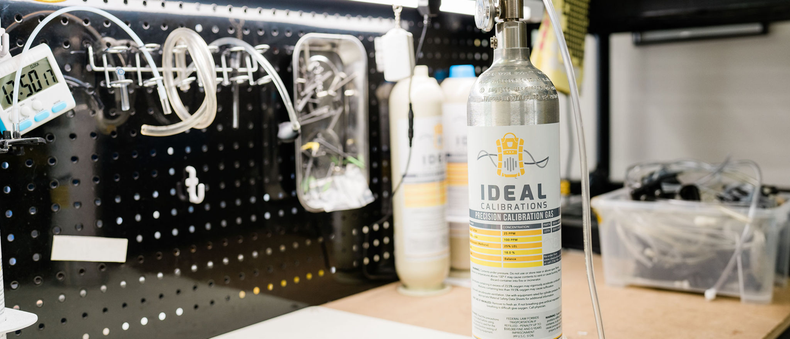
A contractor calls on a Monday morning. Half his crew's monitors failed calibration over the weekend, and the other half passed but then read strangely low on a known H2S source at the job site. The sensors were working fine, the problem was the cylinder. Somebody grabbed a 4-gas off the shelf that was blended for a different brand of instrument, and every detector it touched learned the wrong calibration curves.
A gas detector is only as accurate as the gas used to calibrate it. With the wrong cylinder, an instrument can read low on a real hazard, fail calibration for no obvious reason, or throw off false positive alarms. Here's how to pick the right cylinder, regulator, and calibration equipment.
Why the match matters
During calibration, the detector compares what its sensors read against a gas of known concentration and adjusts itself to match. If the cylinder doesn't match what the instrument expects, whether that's a different concentration, a different combustible gas, or the wrong balance, the detector learns the wrong answer. Equipment manufacturers set calibration safeguards to try and prevent bad calibrations like this, but it can happen. The monitor will pass calibration and still read inaccurately in the field. A failed calibration gets noticed. A bad calibration that still passes goes out on someone's belt and puts them at risk in the field.
Every manufacturer sets a calibration gas specification for its instruments. Make sure your gas cylinder matches it.
Step 1: Start with the manufacturer's spec
The manual or the manufacturer's calibration guide lists the gas your instrument expects, and many units show the expected calibration concentrations in their settings or software.
Look for four things:
- Which gases are in the blend. A standard 4-gas monitor uses O2, LEL combustible, H2S, and CO. Your cylinder may have more or fewer components.
- The concentration of each component
- The combustible gas used, such as methane, pentane, or a pentane simulant
- The balance gas, usually nitrogen or air
If the cylinder you plan to use doesn't match, either change the cylinder or change the instrument's calibration settings to match the gas.
How close are these? Here are four common 4-gas blends:
- Blend 0063 (BW Technologies, GMI, GasClip 4-Gas): 25 ppm H2S, 100 ppm CO, 50% LEL methane, 18.0% vol O2, balance nitrogen
- Blend 0219 (compatible with MSA ALTAIR): 20 ppm H2S, 60 ppm CO, 58% LEL pentane simulant, 15% vol O2, balance nitrogen
- Blend 0149 (RKI 4-Gas): 25 ppm H2S, 50 ppm CO, 50% LEL methane, 12.0% vol O2, balance nitrogen
- Blend 0414 (ISC 4-Gas Pentane Simulant): 25 ppm H2S, 100 ppm CO, 25% LEL pentane simulant, 18% vol O2, balance nitrogen
All four are sold as 4-gas calibration gas. None of them are interchangeable unless you change the instrument's settings. It’s easy to miss if you aren’t paying attention.
Step 2: Check the concentrations and the combustible gas
Toxic gases. H2S and CO are listed in parts per million. The instrument expects a specific ppm value. If your cylinder is 60 ppm CO and the instrument is set for 100 ppm, the calibration will be off.
LEL and the reference gas. The combustible sensor is calibrated to a specific gas, usually methane or pentane. Catalytic bead LEL sensors respond differently to different combustibles, so manufacturers specify which gas to use and at what percentage of the lower explosive limit. Some blends use a pentane simulant, which is methane at a concentration that makes the sensor respond as if it were seeing a stated %LEL of pentane. Confirm the combustible gas, not just the %LEL number.
Oxygen. Many 4-gas blends carry oxygen below normal air levels so the O2 sensor gets checked at a reduced point. Match the manufacturer's spec here too.
Step 3: Pay attention to the balance gas
The balance gas makes up the rest of the cylinder. For most multi-gas blends that include oxygen, it's nitrogen. For some single-gas blends, it may be air or nitrogen depending on the sensor type and the manufacturer's guidance.
Certain sensors need oxygen present to respond correctly, so a nitrogen balance with no oxygen can give poor results on those sensors. If a single-gas cal keeps coming up short, look at the balance.
Step 4: Size the cylinder to your program
Cylinders come in a range of sizes. The right one depends on:
- How many instruments you calibrate or bump test
- How often bump and calibrate
- Your flow rate and how long each calibration runs (usually about 0.2 liters per bump, 1 liter per calibration)
Small fleets usually do best with a smaller cylinder they'll finish before it expires. Larger fleets and docking stations go through more gas and benefit from larger cylinders.
Step 5: Match the regulator to the instrument
The regulator controls how gas leaves the cylinder. The wrong one is a frequent cause of failed or inaccurate calibrations, even when the gas itself is correct.
- Fixed-flow regulators - for diffusion instruments. Diffusion instruments have no internal pump. They rely on gas flowing across the sensors through a cal cap or adapter. A fixed-flow regulator delivers a steady flow, commonly 0.5 LPM for many diffusion monitors, though you should confirm the rate your manufacturer specifies.
- Demand-flow regulators - For pumped instruments. Pumped instruments pull their own sample. A demand-flow regulator releases gas only when the pump draws on it, so the instrument gets gas at the rate it pulls without being over or under pressurized. It also saves gas.
- Tubing and adapters - Keep tubing short and clean, and use material suited to reactive gases. Use the cal cap or adapter designed for your instrument. Leaks and long runs dilute the gas before it reaches the sensor.
Step 6: Watch shelf life and storage
Calibration gas doesn't last forever. Reactive gases like H2S slowly react with the cylinder walls and lose concentration over time, which is why blends with reactive components carry shorter shelf lives than stable gases. Every cylinder should be labeled with an expiration date.
Good habits:
- Check the expiration date before every use, and never use expired gas.
- Store cylinders somewhere cool and dry, away from direct sunlight and heat.
- Rotate stock so older cylinders get used first.
If a calibration fails and you're working off an older cylinder, suspect the gas before you suspect the sensor.
Let us match it for you
At Ideal Calibrations, we blend NIST-traceable calibration gas in-house in Melvindale, Michigan, so we know exactly what goes into every cylinder we ship. Tell us your instrument's make and model, and we'll match the blend, the regulator, and the cylinder size to your program. If you'd rather hand the whole job off, our calibration service can take care of it.
Not sure where to start? Talk to people who work on gas detectors every day. Call Ideal Calibrations at (734) 956-0539 or email support@idealcalibrations.com.