
GfG Polytector III G999 General Information
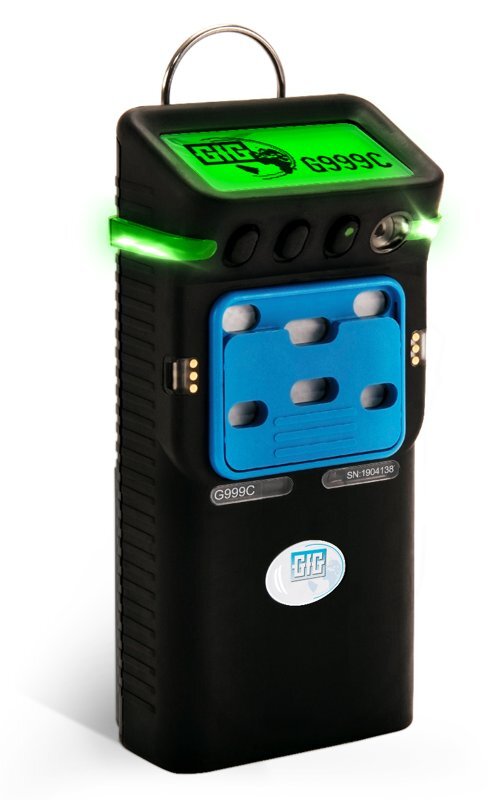
The GfG Polytector III G999 is a five-sensor multi-gas detector with a built-in sample pump. It works as a diffusion personal monitor during the shift, and with the pump switched on it draws samples through a hose or probe to clear confined spaces, shafts and vessels before entry. (Some older GfG data sheets call it the Microtector III G999.)
Every G999 has three electrochemical sensors and one infrared sensor. The fifth position depends on the version: a catalytic %LEL sensor (G999C), a photoionization detector for VOCs (G999P) or a fourth electrochemical sensor (G999E). It shares sensors, chargers, docking stations and the radio system with the compact GfG Microtector III G888C.
Key features
- Built-in pump with flow monitoring: 0.5–0.6 LPM with no restriction, about 0.30 LPM at -4 kPa (about -16 in. H2O), hose runs up to 328 ft (100 m) depending on the gas and hose. The pump starts when the slide switch on the front is pushed up, which also covers the diffusion openings.
- The display shows the current flow rate and the hose length being sampled. A low-flow alarm triggers below about 0.30 LPM.
- Five sensor positions: three electrochemical, one infrared (CO2 and/or hydrocarbons) and one version-specific position (catalytic, PID or a fourth electrochemical sensor).
- Backlit full-graphic display that turns green, amber or red with alarm status, and rotates 180°.
- Three instantaneous alarm levels for O2 and combustibles; two for toxic gases plus STEL and TWA; 103 dB(A) horn (can be reduced to 90 dB(A)) and vibration alarm.
- Man-down alarm; optional 915 MHz radio to a GfG-Link 10 (up to 10 workers) or a PC with G888/G999 Visual software.
- Larger 5.2 V battery than the G888: up to about 130 hours with electrochemical sensors only, and it also powers the pump.
- Explosion-protected LED flashlight; alarm simulation for training; data logger with a 1 s to 60 min interval.
- IP67 rubberized polycarbonate housing with crocodile clip, up to 14 oz (395 g).
G999 Model Versions
| Version | Fifth sensor position | Typical use | Hazardous location marking (ATEX) |
|---|---|---|---|
| G999C | Catalytic bead, 0–100% LEL | Confined-space entry: O2, LEL, CO, H2S, plus IR and other toxics | I M2 Ex ia db I Mb; II 2G Ex ia db IIC T4 Gb |
| G999P | Photoionization (PID), 10.6 eV lamp | VOCs and fuels along with toxic gases | I M1 Ex ia I Ma; II 1G Ex ia IIC T4 Ga |
| G999E | Fourth electrochemical sensor | Several toxic gases at once, H2 or O2 | I M1 Ex ia I Ma; II 1G Ex ia IIC T4 Ga |
| G999S | Hybrid catalytic/thermal-conductivity (optionally semiconductor) sensor | Natural gas and hydrogen work: %LEL, 0–100% vol CH4 or 0–25% vol H2, and ppm leak search (3-element version) | See the G999S data sheet |
GfG also offers the TeamLink G999L, a connected safety monitor for supervising up to 10 G888/G999 users by radio. Each G999 version (C, E, P) uses its own battery pack. Confirm the US part number with GfG (the international manual lists 1990301, 1990302 and 1990303).
Standard Sensor Options for the GfG G999
| Gas | Sensor type | Measuring range | Resolution | Expected sensor life | GfG USA part number |
|---|---|---|---|---|---|
| Oxygen (O2) | Electrochemical | 0–25% vol | 0.1% vol | 5 years | 1990718 |
| Combustibles (%LEL) | Catalytic bead | 0–100% LEL or 0–5.00% vol CH4 | 0.5% LEL | 3 years | 1990851 |
| Carbon monoxide (CO) | Electrochemical | 0–500 ppm (1,000 or 2,000 ppm selectable) | 1 ppm | 3 years | 1990705 |
| Hydrogen sulfide (H2S) | Electrochemical | 0–100 ppm (50, 200 or 500 ppm selectable) | 0.1 ppm (0.2 ppm at 200, 0.5 ppm at 500) | 3 years | 1990700 |
| CO + H2S combination (COSH) | Electrochemical, one slot | 0–500 ppm CO / 0–100 ppm H2S | 1 ppm CO / 0.2 ppm H2S | 3 years | Confirm US PN with GfG |
| Carbon dioxide (CO2) | Infrared | 0–5%, 0–15% or 0–25% vol | 0.01–0.05% vol (0–5% range) | 6 years | Confirm US PN with GfG |
| Hydrocarbons | Infrared | 0–100% LEL, or 0–100% LEL plus 0–100% vol CH4 | 0.2–1.0% LEL | 6 years | Confirm US PN with GfG |
| CO2 + hydrocarbons | Infrared combination | 0–5% vol CO2 and 0–100% LEL | — | 6 years | Confirm US PN with GfG |
| VOCs (G999P only) | PID, 10.6 eV | 0–2,000 ppm isobutylene (0–800 to 0–6,000 ppm ranges available) | 0.2 ppm below 100 ppm on the 0–800/0–1,000 ppm ranges | 2–3 years | Confirm US PN with GfG |
US part numbers for the O2, LEL, CO and H2S sensors are from GfG USA's G999 field operation manual (7004-999). GfG USA has not published US part numbers for the other sensors in its G999 documents. Ranges, resolutions and expected life are from GfG's G999 operating manual and are for clean air. The catalytic sensor fits only the G999C, the PID only the G999P and the fourth EC sensor only the G999E. For reference only, the international manual lists O2 1990715/1990716/1990717, standard LEL 1990850, COSH 1990710, CO2 1990900/1990901/1990902, hydrocarbon IR 1990905/1990906, CO2 + hydrocarbon IR 1990920 and PID 1990980.
Other Electrochemical Sensors Available for the G999
| Gas | Measuring range | Resolution |
|---|---|---|
| Ammonia (NH3) | 0–300 ppm or 0–1,000 ppm | 1 ppm (0–300 ppm); 5 ppm (0–1,000 ppm) |
| Chlorine (Cl2) | 0–10 ppm (20 or 40 ppm selectable) | 0.05 ppm (0.1 ppm on 0–40 ppm) |
| Chlorine dioxide (ClO2) | 0–2 ppm | 0.01 ppm |
| Ethylene oxide (C2H4O) | 0–20 ppm (50 or 100 ppm selectable) | 0.1 ppm |
| Hydrogen (H2) | 0–2,000 ppm, 0–1.00% vol or 0–4.00% vol | 2 ppm / 0.01% vol |
| Hydrogen chloride (HCl) | 0–30 ppm (50 ppm selectable) | 0.2 ppm |
| Hydrogen cyanide (HCN) | 0–50 ppm (100 ppm selectable) | 0.1 ppm (0.2 ppm on 0–100 ppm) |
| Hydrogen fluoride (HF) | 0–10 ppm | 0.5 ppm |
| Nitric oxide (NO) | 0–100 ppm (50 or 200 ppm selectable) | 0.2–0.5 ppm |
| Nitrogen dioxide (NO2) | 0–30 ppm (50 or 100 ppm selectable) | 0.1 ppm |
| Phosgene (COCl2) | 0–2 ppm | 0.01 ppm |
| Phosphine (PH3) | 0–10 ppm (20 or 50 ppm selectable) | 0.05 ppm |
| Silane (SiH4) | 0–20 ppm (50 ppm selectable) | 0.1 ppm |
| Sulfur dioxide (SO2) | 0–10 ppm (20, 50 or 100 ppm selectable) | 0.05–0.1 ppm |
GfG USA has not published US part numbers for these sensors in its G888/G999 documents, so confirm the part number with GfG when ordering. For reference only, GfG's international operating manual lists NH3 1990735/1990740, Cl2 1990725, ClO2 1990730, EtO 1990775, H2 1990785/1990790/1990795, HCl 1990755, HCN 1990760, HF 1990766, NO 1990745, NO2 1990750, COCl2 1990800, PH3 1990770, SiH4 1990780 and SO2 1990720.
PID response factors (G999P, isobutylene = 1.00)
Multiply the isobutylene-equivalent reading by the response factor to estimate the concentration of a known compound. Values are from GfG's G999 operating manual.
| Compound | Response factor | Compound | Response factor |
|---|---|---|---|
| Benzene | 0.53 | Acetone | 1.20 |
| Toluene | 0.53 | n-Hexane | 4.50 |
| Xylene | 0.50 | Heptane | 2.50 |
| Styrene | 0.40 | Ammonia | 9.40 |
| Diesel fuel #2 | 0.75 | Hydrogen sulfide | 3.20 |
| Jet A fuel | 0.40 | Butadiene | 0.69 |
Specifications
| Specification | GfG Polytector III G999 |
|---|---|
| Sampling | Diffusion with the pump off; remote sampling with the pump on (sensor cover closed) |
| Pump | 0.5–0.6 LPM at 0 kPa; 0.30 LPM at -4 kPa (about -16 in. H2O); 0 LPM at -10 kPa (about -40 in. H2O); up to 328 ft (100 m) of hose depending on gas and hose; low-flow alarm below about 0.30 LPM |
| Display | Backlit full-graphic LCD; backlight green, amber or red by alarm status; rotates 180° |
| Alarms | O2 and combustibles: 3 instantaneous levels; toxics: 2 instantaneous plus STEL and TWA; battery, pump-flow and man-down alarms |
| Audible alarm | 103 dB(A), can be reduced to 90 dB(A) |
| Battery | Rechargeable NiMH module, 5.2 V, 2,100 mAh |
| Run time, diffusion, no radio (new battery, 68°F / 20°C) | About 130 h (EC); 52 h (EC + PID); 47 h (EC + IR); 42 h (EC + catalytic with PowerSave); 26 h (EC + catalytic with PowerSave + IR) |
| Run time with pump running | About 17 h (EC + IR); 14 h (EC + PID + IR); 13 h (EC + catalytic); 11 h (EC + catalytic + IR) |
| Operating conditions | -4 to +122°F (-20 to +50°C), 5–95% RH, 70–130 kPa (about 10–19 psia) |
| Storage | -13 to +131°F (-25 to +55°C); 32 to 86°F (0 to 30°C) recommended |
| Dimensions | 2.7 x 5.4 x 1.5 in (68 x 136 x 39 mm), W x H x D |
| Weight | Up to 14 oz (395 g), depending on sensors |
| Ingress protection | IP67 |
| Radio (optional) | 915 MHz (US), about 985 ft (300 m) free-field range. EU versions use 868 MHz. |
| Data logging | Average, peak or instantaneous values; 1 s to 60 min interval; ring memory |
| Hazardous location (North America) | GfG's 2023 US data sheet lists CSA C22.2 No. 152 as pending. It does not state a North American certification mark for the G999. Check the label on your instrument or confirm with GfG before use in a classified location. |
| Hazardous location (ATEX/IECEx) | See model versions above; BVS 15 ATEX E 064 X; IECEx BVS 15.0056 X; -20°C ≤ Ta ≤ +50°C (-4 to +122°F) |
| Warranty (GfG USA) | Limited lifetime on the instrument while in service; LEL, CO and H2S sensors 3 years; O2 sensor 5 years; consumable accessories 1 year |
Sampling with the Built-in Pump
- Plug the hose connector (with filter insert) into the opening on the underside, then push the slide switch on the front up to start the pump. This also closes the diffusion openings. Push it down to stop the pump.
- GfG's minimum sampling time is 10 seconds, plus about 1 second per foot (3 seconds per meter) of 3/16 in. (5 mm) ID hose, plus 10 seconds if the telescopic probe is used. For example, a 10 ft hose needs at least about 19 seconds, and a 20 ft hose about 28 seconds.
- Keep sampling lines as short as practical. A float probe keeps standing water from being drawn in, and an in-line hydrophobic filter protects against water and particles.
- For H2S and solvent vapors, GfG offers a Viton hose that resists them.
- Check the low-flow alarm before each use by blocking the inlet.
Bump Testing and Calibrating the GfG G999
- GfG recommends a bump test before each day's use: expose the sensors to gas above the alarm set points and confirm the audible and visual alarms. Calibrate if readings are outside limits.
- Calibrate before first use and then on a regular schedule. How often depends on how much the instrument is used and what the sensors are exposed to. Follow your company's program and any regulations that apply.
- The instrument tracks bump, calibration and maintenance due dates and shows "Bump test/maintenance overdue" or "Recalibration needed" at start-up when one is past due.
- Apply gas through the Smart Cap (1990210) at 0.5–0.6 LPM, the flow GfG specifies. Our 0.5 LPM Fixed Flow C10 Calibration Gas Regulator fits our 34 L, 58 L and 116 L aluminum and 103 L steel cylinders; choose the stainless steel version for reactive gases such as ammonia or chlorine.
- Let the sensors warm up fully before calibrating, especially the catalytic sensor. About five minutes is usually enough.
- The catalytic sensor is factory calibrated to 50% LEL methane. If you monitor a different flammable gas in the %LEL range, calibrate with that gas.
- For some very reactive gases, GfG's G999 manual says to apply test gas with the Smart Cap or the built-in pump instead of a docking station.
AutoCal procedure
- In clean air, turn the instrument on and let readings stabilize.
- Press the center and right buttons together to open the AutoCal menu, then press AIR. The instrument zeros the toxic and combustible sensors and sets O2 to 20.9%, then shows OK for each sensor that passes.
- Attach the Smart Cap and connect the regulator and tubing to the cylinder.
- Open AutoCal again, start the gas flow and press GAS. Calibration starts automatically after about 10 seconds and takes about 45 seconds. One cylinder of 4-gas mix calibrates the LEL, CO and H2S sensors at the same time.
- Confirm OK for each sensor, close the regulator and remove the Smart Cap before returning to service.
- If a sensor fails, repeat the step at least once. Check that the cylinder isn't empty and that the cylinder, tubing and cap are connected properly. GfG says a sensor that still fails must be replaced before the instrument is used.
Recommended calibration gas
| Sensors | Calibration gas (GfG specification) | Matching Ideal Calibrations gas |
|---|---|---|
| O2, LEL (methane), CO, H2S | 50% LEL methane, 18% O2, 200 ppm CO, 20 ppm H2S, balance N2 (GfG 7802-030 / 7803-030 / 7804-030) | Calibration Gas Blend 0481 (same composition) |
| Fresh-air adjustment (sets O2 to 20.9% and toxics/LEL to zero) | Clean fresh air with no measurable contaminants. A cylinder of zero air is an alternative where clean air can't be assured (our suggestion, not a GfG requirement). | Zero Air |
| CO2 (IR) | 4% vol CO2, balance N2 (GfG 7802-032). Because ambient air contains CO2, GfG's operating manual says to zero the CO2 sensor with CO2-free zero gas, such as synthetic air, 100% nitrogen or specially purified air. | Carbon Dioxide (CO2) calibration gas (4% vol, N2 balance); Zero Nitrogen (N2) or Zero Air for zero |
| LEL on a gas other than methane | 50% LEL of the target gas, e.g. propane (GfG 7802-012) | Propane (C3H8) calibration gas, Methane (CH4) calibration gas |
| PID (VOC) – G999P | 100 ppm isobutylene in air (GfG 7802-024); GfG also lists 200 ppm (7802-224) | Isobutylene (C4H8) calibration gas (100 ppm, air balance) |
For other toxic sensors, use single-gas cylinders at the concentrations GfG lists, for example Ammonia (NH3) calibration gas, Chlorine (Cl2) calibration gas, Nitrogen Dioxide (NO2) calibration gas, Sulfur Dioxide (SO2) calibration gas, Hydrogen Cyanide (HCN) calibration gas, Hydrogen (H2) calibration gas or Phosphine (PH3) calibration gas. The span value entered in the instrument must match the cylinder label. For a general walkthrough, see How to Calibrate Gas Detectors.
Catalytic LEL response to other gases
A catalytic sensor calibrated on methane does not read every flammable gas the same way. Heavier hydrocarbons such as propane, pentane or hexane typically read low on a methane calibration. GfG publishes response data in its manuals, but the figures differ between the US field manual and the international operating manual, which describe different catalytic sensor models. If you monitor a gas other than methane, calibrate with that gas or ask GfG for the response data for the sensor in your instrument.
Maintenance and Sensor Life
- Clean the housing with a damp cloth and clear water only. Do not use solvents or detergents.
- Keep the charging contacts clean, and charge or open the instrument only outside hazardous areas.
- Before each use, check the sampling hose, filters and probe, and block the pump inlet to confirm the low-flow alarm works. The instrument shows "PUMP Flow error!" below about 0.30 LPM.
- Protect the catalytic sensor from silicones, sulfur compounds, halogenated hydrocarbons and lead compounds. After a known exposure, check it with calibration gas. Do not test it with a butane lighter.
- Above 110% LEL, the instrument shows over-range and switches off the catalytic sensor to protect it. Alarms stay on until reset in fresh air. Recalibrate, or replace the sensor if needed, after a high-concentration exposure.
- Expected sensor life in clean air: CO and H2S about 3 years; O2 about 5 years (US replacement sensor 1990718); catalytic 3 years; infrared 6 years; most other toxic sensors 1–3 years.
- Store spare sensors at 32–86°F (0–30°C). Use electrochemical spares within 6 months, and remove the battery if the instrument will be stored longer than 6 months.
- Turning the instrument off resets TWA, STEL and peak values, so leave it on for the whole shift.
Accessories and Part Numbers
| Accessory | GfG USA part number | Notes |
|---|---|---|
| G888/G999 Smart Cap (calibration cap, data transfer) | 1990210 | Fits over the diffusion inlets for calibration gas at 0.5–0.6 LPM. GfG's G999 field manual lists the drop-in charger (cradle) for charging. |
| Drop-in charger DIC 888/999, without plug-in power supply | 1990220 | Shared with the G888 |
| Plug-in wall charger, 110 V AC (for the drop-in charger) | 4001-650 | |
| Vehicle charger | 4001-650V | GfG Vehicle Charger (4001-650V) |
| USB data cable, drop-in charger to PC | 1990229 | |
| Data logger kit (software, cable, Smart Cap) | 1990205 | |
| Protective case with display cover and carrying straps (G999) | 1990298 | |
| RF transceiver USB dongle, 915 MHz, with G888/G999 Visual software (Windows) | 1990202 | For radio-equipped instruments |
| Sampling hose, anti-static, with dust/water filter, 10 ft | 1000208 | |
| Sampling hose, anti-static, with dust/water filter, 20 ft | 1000210 | |
| In-line hydrophobic barrier filter, pack of 3 | 1000207 | GfG hydrophobic barrier filter for sample tubing, 3-pack (1000207) |
| Telescopic probe, stainless (CrNi) steel, 4.5 ft | 1000205 | GfG stainless steel probe, 4.5 ft (1000-205) |
| Telescopic probe, stainless (CrNi) steel, 6 ft | 1000206 | GfG stainless steel probe, 6 ft (1000-206) |
| Float probe type C | 1000225 | |
| Hose connector with filter insert | Confirm US PN with GfG | International manual: 1990305 |
| Filter elements for hose connector, pack of 10 | Confirm US PN with GfG | International manual: 1990306 |
| Viton hose, resistant to solvents and H2S | Confirm US PN with GfG | International manual: 1000217 |
| DS400 docking station (1 gas input) | 1450-406 | Shared with the G888 |
| DS404 docking station (4 gas inputs) | 1450-407 | Shared with the G888 |
Related GfG Gas Detectors
- GfG Microtector III G888C: diffusion-only personal monitor with the same sensors and accessories as the G999.
- GfG G222E (Micro 5): 1- or 2-gas electrochemical detector.
- G450 and G460: GfG Microtector II detectors. GfG describes the G450 as a 4-gas detector and the G460 as a multi-gas detector for up to 7 gases.
- All GfG Instrumentation gas detector guides.
Reference documents
Information on this page comes from these GfG documents. Where they disagree, we use the newest US document and note the difference.
- Microtector III G999 data sheet (US) (G999US, 07/17/2023)
- G999 Multi-gas Detector Field Operation Manual (7004-999 Rev. 2, 11/25/2024)
- G999 with pump Quick Reference Guide (as of 02/10/2026)
- G888/G999 Quick Reference Guide pocket card (7001-888 Ver. 2.0)
- G999 Operating Manual (international edition) (215-100.30, firmware 1.60, 02/18/2020)
- Polytector III G999 accessory list (US)
- G999S data sheet (Rev. 1, 02/11/2025)
- GfG USA product pages: Polytector III G999C (also G999E, G999P, G999S and TeamLink G999L; viewed November 2026)
- GfG USA test gas list (gfgsafety.com, viewed November 2026)