
GfG G222E (Micro 5) General Information
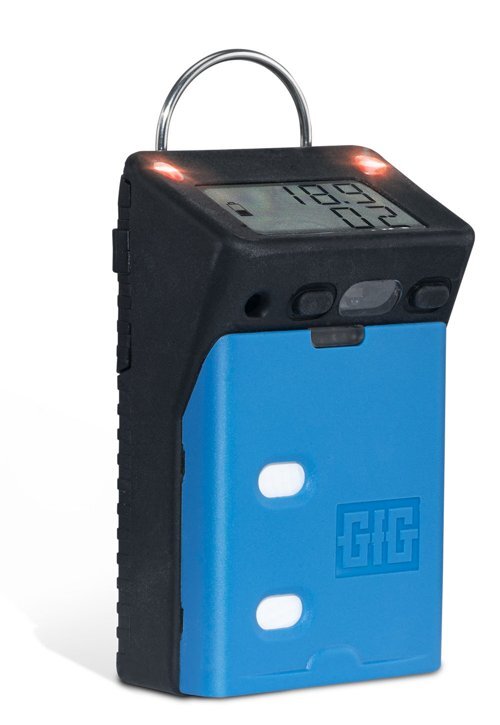
The GfG G222E, the first instrument in GfG's Micro 5 series, is a compact 1- or 2-gas personal detector with two slots for smart electrochemical sensors. Any combination of the available sensors can be installed, including two of the same type for redundancy. A single-gas unit runs with a dummy sensor in the second slot.
Because it uses electrochemical sensors only, the G222E covers toxic gases, oxygen and hydrogen but not %LEL combustibles or CO2. It runs on one AA alkaline battery, so it suits workers who need a low-maintenance personal monitor for one or two specific hazards, such as CO and H2S, ammonia, chlorine or phosphine. For combustibles, CO2 or pumped sampling, see the GfG Microtector III G888C and GfG Polytector III G999.
Key features
- Two smart electrochemical sensor slots, with sensors for about 20 gases.
- 2 x 4-digit LCD with backlight. Pressing both buttons rotates it 180° for reading while worn.
- Two very bright red alarm LEDs, a 95 dB(A) horn (per the G222E manual) and a vibration alarm.
- Up to 3 instantaneous alarm levels (O2 and H2), 2 for toxic gases, plus STEL and TWA.
- Single AA alkaline battery: about 9 months at 10 hours a day, or about 90 days running 24/7, depending on sensors. GfG notes that lead-free O2 sensors shorten this.
- Internal data logger stores 2,600 records (more than 60 hours at a 60-second interval), read through the infrared interface with the Smart Cap and PGDConfig software and exported to PDF or CSV.
- Two-button operation; shows overdue-service reminders at start-up.
- IP54 rubberized housing, 4.4–4.9 oz (123–138 g) depending on sensors, per the G222E manual.
Standard Sensor Settings for the GfG G222E
Measuring ranges, typical alarm thresholds, test gas concentrations and sensor part numbers are from GfG's G222E operations manual (Rev. 2, November 2024). GfG lists these thresholds as typical values. Each G222E ships with its own configuration record and shows its active alarm thresholds during start-up, so check the settings on your unit.
| Gas | Measuring range | Typical alarm thresholds (A1 / A2 / A3) | Test gas | GfG USA sensor part number | Matching Ideal Calibrations gas |
|---|---|---|---|---|---|
| Oxygen (O2) | 0–25% vol | 19.5 / 17.0 / 23.5% vol | 20.9% (fresh air); zero with 100% N2 | 1990718 (5-year) | Zero Air; Zero Nitrogen (N2) for zero |
| Carbon monoxide (CO) | 0–500 ppm | 35 / 50 ppm | 200 ppm | 1990705 | Carbon Monoxide (CO) calibration gas |
| Hydrogen sulfide (H2S) | 0–100 ppm | 10 / 30 ppm | 20 ppm | 1990700 | Hydrogen Sulfide (H2S) calibration gas |
| Nitric oxide (NO) | 0–100 ppm | 25 / 50 ppm | 50 ppm | 1990745 | Nitric Oxide (NO) calibration gas |
| Ammonia (NH3) | 0–200 ppm | 20 / 40 ppm | 100 ppm | 1990736 | Ammonia (NH3) calibration gas |
| Hydrogen cyanide (HCN) | 0–50 ppm | 5 / 10 ppm | 20 ppm | 1990760 | Hydrogen Cyanide (HCN) calibration gas |
| Hydrogen chloride (HCl) | 0–30 ppm | 5 / 10 ppm | 10 ppm | 1990755 | Hydrogen Chloride (HCl) calibration gas |
| Ethylene oxide (C2H4O) | 0–20 ppm | 2 / 5 ppm | 10 ppm | 1990775 | – |
| Chlorine dioxide (ClO2) | 0–2 ppm | 0.1 / 0.2 ppm | 1.0 ppm | 1990730 | – |
| Phosgene (COCl2) | 0–2 ppm | 0.1 / 0.2 ppm | 1.0 ppm | 1990800 | – |
| Phosphine (PH3) | 0–10 ppm | 0.3 / 1 ppm | 5.0 ppm | 1990770 | Phosphine (PH3) calibration gas |
| Silane (SiH4) | 0–20 ppm | 5 / 10 ppm | 10 ppm | 1990780 | – |
| Hydrogen fluoride (HF) | 0–10 ppm | 1.0 / 2.0 ppm | 10.0 ppm | 1990765 | – |
| Chlorine (Cl2) | 0–10 ppm | 0.5 / 1.0 ppm | 10.0 ppm | 1990725 | Chlorine (Cl2) calibration gas |
| Ozone (O3) | 0–1 ppm | 0.1 / 0.2 ppm | 1.0 ppm | 1320815 | – |
| Nitrogen dioxide (NO2) | 0–30 ppm | 3 / 5 ppm | 10 ppm | 1990750 | Nitrogen Dioxide (NO2) calibration gas |
| Sulfur dioxide (SO2) | 0–10 ppm | 2 / 5 ppm | 5 ppm | 1990720 | Sulfur Dioxide (SO2) calibration gas |
| Hydrogen (H2) | 0–4.00% vol | 0.2 / 0.4 / 0.6% vol | 2% vol | 1990795 | Hydrogen (H2) calibration gas |
Other G222E Sensor Ranges
| Gas | Measuring range | GfG USA sensor part number |
|---|---|---|
| Ammonia (NH3) | 0–300 ppm / 0–1,000 ppm | 1990735 / 1990740 |
| Hydrogen (H2) | 0–2,000 ppm / 0–1.00% vol | 1990785 / 1990790 |
| tert-Butyl mercaptan (TBM) | 0–20 ppm | 1320810 |
| Tetrahydrothiophene (THT) | 0–25 ppm (data sheet lists 0–20 ppm) | 1990805 |
| Oxygen (O2) | 0–25% vol, 2-, 3- or 5-year versions (data sheet) | 1990718 (5-year) |
Many G222E sensors can also be set to other ranges. TBM and THT are odorants used in natural gas.
Specifications
| Specification | GfG G222E |
|---|---|
| Sensors | Two smart electrochemical slots (toxic gases, O2, H2) |
| Sampling | Diffusion |
| Display | 2 x 4-digit LCD with backlight; shows battery level and gas readings with units; rotates 180° |
| Controls | 2 buttons |
| Alarms | 2 red LEDs, audible and vibration; 3 or 2 instantaneous levels depending on gas, plus STEL (15 min) and TWA (8 h); battery alarm |
| Audible alarm | 95 dB(A), per the G222E manual |
| Power | One replaceable 1.5 V AA alkaline battery of a GfG-approved type (GfG part 1318201). The G222E manual permits Duracell Industrial ID1500 (LR6 AA), Duracell Procell PC1500 (LR6 AA) and Energizer EN91 Industrial AA. Replace only outside hazardous areas. |
| Battery life | Sensor dependent; about 9 months at 10 h/day or 90 days running 24/7 |
| Data logger | 2,600 records (current values, alarms, STEL/TWA, time, temperature, battery voltage); IrDA readout with PGDConfig |
| Operating conditions | -4 to +131°F (-20 to +55°C), with +113°F (+45°C) given in brackets as the upper limit, matching the ATEX T3 and T4 markings, per the G222E manual; 5–95% RH; 70–130 kPa (about 10–19 psia) per the 2026 data sheet |
| Storage | -13 to +131°F (-25 to +55°C), with +113°F (+45°C) in brackets; 32 to 86°F (0 to 30°C) recommended, per the G222E manual |
| Dimensions | 2 x 3.35 x 1 in (50 x 85 x 27 mm), W x H x D, per the G222E manual |
| Weight | 4.4–4.9 oz (123–138 g) depending on sensor configuration, per the G222E manual |
| Ingress protection | IP54 |
| Hazardous location (North America) | GfG's G222E data sheet and manual do not list a CSA or UL rating. Confirm with GfG before using it in a US or Canadian classified location. |
| Hazardous location (ATEX/IECEx) | II 1G Ex ia IIC T3 Ga (-20°C ≤ Ta ≤ +55°C, -4 to +131°F); II 1G Ex ia IIC T4 Ga (-20°C ≤ Ta ≤ +45°C, -4 to +113°F); BVS 18 ATEX E 027 X; IECEx BVS 18.0020 X, per the 2026 data sheet. GfG's website and 2024 manual also list a mining marking (I M1 Ex ia I Ma). The manual says the device checks that only batteries covered by the certificate are used. |
Bump Testing and Calibrating the GfG G222E
- Calibration and bump testing need only the Calibration Cap (1320250), a regulator, tubing and a cylinder matched to the installed sensors. The Smart Cap (1320251/1320252) adds the infrared data link for reading the data logger.
- Apply gas at 0.5–0.6 LPM, the flow GfG specifies. Our 0.5 LPM Fixed Flow C10 Calibration Gas Regulator fits our 34 L, 58 L and 116 L aluminum and 103 L steel cylinders; choose the stainless steel version for reactive gases such as ammonia or chlorine.
- Zero in clean fresh air. For O2 sensors, GfG specifies zeroing with 100% nitrogen and spanning with fresh air or an oxygen-containing test gas.
- Calibrate only in a well-ventilated area. Vent the cap's upper outlet with exhaust tubing if needed.
- GfG's website describes attaching the Calibration Cap for the daily bump test. Calibrate on your company's schedule. The G222E shows overdue-service reminders at start-up.
- Calibration is done in the password-protected service menu. Enter the span value printed on the cylinder before applying gas.
Calibration steps
- Turn the instrument on and let it finish its self-test and warm-up.
- Open the service menu (hold the left button) and enter the service code.
- Select the zero adjustment for sensor 1 and start it in fresh air. The display alternates between the gas name and "JSTG" and shows OK or ERR when done. Save with the right button.
- Select the sensitivity (span) adjustment and check that the test gas value matches your cylinder.
- Clip the Calibration Cap onto the sensor cover, connect the tubing to the lower inlet, open the regulator and start the adjustment with the left button.
- When the reading stabilizes and OK is shown, close the regulator, save, and repeat for sensor 2 if installed. Remove the cap before returning to service.
Maintenance and Sensor Life
- Replace the AA battery only outside hazardous areas, and only with a GfG-approved type. The battery icon flashes below 5% charge.
- To remove the cover, loosen only the bottom safety screw. Do not loosen the housing mounting screws.
- Keep the alarm opening and diffusion openings clear. Clean with a damp cloth only.
- Smart sensors can be swapped easily. GfG describes them as durable and easy to change.
- O2 sensors come in 2-, 3- and 5-year versions (per the data sheet). Life for other sensors depends on the sensor type and exposure.
Accessories and Part Numbers
| Accessory | GfG USA part number |
|---|---|
| Calibration cap for zero and test gas | 1320250 |
| Smart calibration cap with IR interface, without USB cable | 1320251 |
| Smart calibration cap with IR interface and USB cable (datalogging kit) | 1320252 |
| G222 data logger software (PGDConfig) on USB stick | 1320255 |
| Replacement battery (GfG-approved AA) | 1318201 |
| DS400 docking station for G222E (1 gas cylinder) | 1320271 |
| DS404 docking station for G222E (up to 4 gas cylinders) | 1320276 |
Related GfG Gas Detectors
- GfG Microtector III G888C: diffusion-only personal monitor with the same sensors and accessories as the G999.
- GfG Polytector III G999: five-sensor monitor with a built-in pump for confined-space entry testing.
- G450 and G460: GfG Microtector II detectors. GfG describes the G450 as a 4-gas detector and the G460 as a multi-gas detector for up to 7 gases.
- All GfG Instrumentation gas detector guides.
Reference documents
Information on this page comes from these GfG documents. Where they disagree, we use the newest US document and note the difference.
- G222E data sheet (Rev. 3, 01/28/2026)
- G222E Operations Manual (Rev. 2, 11/07/2024)
- G222E Quick Reference Guide (as of 02/10/2026)
- G222E Quick Reference Guide: Adjustment (as of 02/10/2026)
- Micro 5 G222E accessory list
- GfG USA product page: G222E Micro 5 (gfgsafety.com, viewed November 2026)
- GfG USA test gas list (gfgsafety.com, viewed November 2026)