
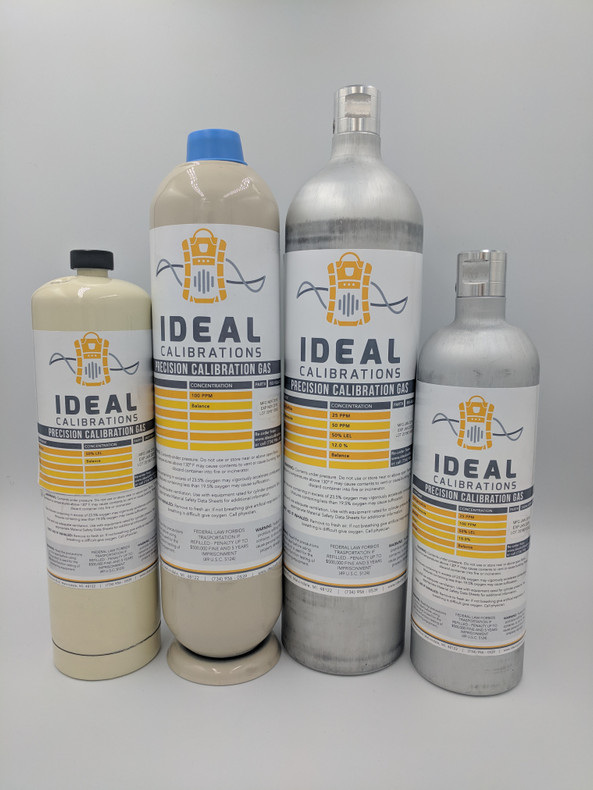
In the world of industrial safety, a portable gas detector is more than just a piece of hardware; it is a life-preserver with a digital display. At Ideal Calibrations, we process thousands of monitors every year, and we see everything from pristine units to detectors that look like they’ve been through a war zone.
While most safety managers understand the basic "bump daily, calibrate monthly" mantra, true experts know that maintenance doesn’t stop at the calibration cap. To maintain a fleet that actually protects your crew, you need an understanding of troubleshooting, sensor chemistry, and the subtle "red flags" that a standard calibration might miss.
This guide dives deep into the technical side of gas detector maintenance and troubleshooting, offering process-improvement suggestions that move your program from reactive to proactive.
The Philosophy of Proactive Maintenance
For an expert, maintenance is not a chore—it is data collection. Every time a detector fails a bump test or shows significant drift during calibration, it is telling you something about your environment or your process.
If you are simply recalibrating and moving on, you are missing the opportunity to prevent the next failure. At Ideal Calibrations, we advocate for a total systems approach. This means looking at the instrument, the environment, and the calibration gas (calgas) as a single, interconnected system.
Deep Dive: Troubleshooting Common Sensor Failures
When a sensor fails to calibrate or responds sluggishly, the "fix" isn't always a new sensor. Understanding the why is what separates a technician from an expert.
1. LEL (Combustible) Sensor Poisoning
The Pellistor (catalytic bead) sensor is the workhorse of LEL detection, but it is also the most vulnerable.
- The Symptom: The monitor fails to span during calibration or shows "Sensor Error" despite being relatively new.
- The Cause: Exposure to "poisons" like silicones (found in many lubricants and cleaners), lead, or sulfur compounds. These substances coat the bead, preventing the catalytic reaction.
- Expert Suggestion: Review your facility’s cleaning supplies and lubricants. If you are seeing frequent LEL failures in a specific department, check for silicone-based sprays. Switching to "sensor-safe" chemicals can save thousands in replacement costs.
2. Oxygen Sensor Depletion
Oxygen sensors are essentially batteries that consume themselves to produce a signal.
- The Symptom: Constant "low O2" alarms in fresh air or a sensor that won't "zero" (or "20.9") during a fresh-air startup.
- The Cause: The electrolyte is spent. Heat and low humidity can accelerate this, essentially "drying out" the sensor.
- Expert Suggestion: Monitor the age of your O2 sensors. Most have a 2-year life. If you’re seeing failures at the 12-month mark, evaluate your storage conditions. Storing monitors in a climate-controlled environment—rather than a hot truck—drastically extends O2 sensor life.
3. Electrochemical Drift (CO, H2S, etc.)
- The Symptom: Excessive "negative drift" or "cross-sensitivity" alarms.
- The Cause: High-stress environments (high humidity followed by extreme dryness) can cause the electrolyte to swell or contract, affecting the baseline.
- Expert Suggestion: Don't just hit "auto-zero." If a sensor is drifting significantly every week, it’s often a sign of environmental stress or exposure to a background gas that is "scrubbing" the sensor electrodes.
Troubleshooting the "Support System"
Often, the detector is fine, but the equipment used to maintain it is faulty. Experts check the chain of calibration before condemning a $200 sensor.
The Calgas Cylinder
Is your gas actually what it says it is?
- Expiration Dates: This is non-negotiable. Reactive gases like H2S and SO2 are notoriously unstable. Over time, the gas reacts with the cylinder walls, and a 25 ppm bottle might only be putting out 15 ppm. This leads to false calibrations where you are essentially telling the detector that a weak gas is a strong gas.
- Cylinder Pressure: Never calibrate with a tank below 80 PSI. The flow rate and concentration can become inconsistent as the tank nears empty.
Regulators and Tubing
- The Adhering Gases: If you are using standard Tygon tubing for reactive gases like Cl2 or NH3, the gas can "stick" to the walls of the tube. This results in slow T90 response times and failed calibrations.
- Expert Suggestion: Use Teflon-lined tubing for any highly reactive gas. It ensures the gas reaches the sensor at the intended concentration immediately.
- Flow Rates: Ensure your regulator matches the manufacturer's spec (typically 1.0 Liters Per Minute for highly reactive gases). A mismatch in flow can lead to pressure differentials on the sensor, causing inaccurate span settings and slower flow rates cause highly reactive gases to sit in an improper tubing environment longer.
Improving Your Process: 3 Suggestions for Experts
If you want to move your safety program to the next level, consider implementing these three strategies used by the most sophisticated fleets in the country.
1. Implement End-of-Life Tracking
Most docking stations record the span reserve. This is a measurement of how much juice the sensor has left.
- Our Advice: Don't wait for a sensor to fail. If a sensor’s span reserve is below 20%, replace it during scheduled maintenance. This prevents "nuisance failures" in the field that stop work and frustrate your crews.
2. Standardize Your Fresh Air Environment
The Zero or Fresh Air calibration is the foundation of the detector's math. If you zero a monitor in a room with background exhaust or VOCs, every reading for the rest of the day will be skewed.
- Our Advice: If your facility doesn't have a guaranteed "clean air" zone, use a Zero Air cylinder. It removes the variable of environmental contamination entirely.
3. Centralize Your Records
Paper logs are where data goes to die. In a high-stakes environment, you need to be able to prove compliance in seconds.
- Our Advice: Use a cloud-based management system. At Ideal Calibrations, we help companies transition to digital tracking where every serial number has a searchable birth-to-death history.
Maintenance Checklist for High-Reliability Fleets
Before a detector leaves the tool crib, it should pass this expert-level inspection:
- Physical Integrity: Check the sensor filters. If they are discolored or clogged with dust/oil, the gas cannot reach the sensor.
- Pump Test: If the unit has an internal pump, block the inlet. The unit should immediately sound the pump alarm. If it doesn't you most likely have an internal leak or a bad pump, and the unit is unsafe for confined space entry.
- Alarm Verification: It’s not enough to see the lights. Check the audible alarm and the vibration motor. In a high-noise environment, a silent detector is a paperweight.
Why "Ideal Calibrations" is the Trusted Choice for Experts
You are an expert in your field—whether that’s refining, mining, or emergency response. You shouldn't have to be a chemist and an electronics technician on top of that.
At Ideal Calibrations, we live and breathe this technology. We aren't just a shop that swaps parts; we are a diagnostic center.
What Sets Us Apart?
- Fast-Turnaround: We know that a detector sitting on a bench isn't protecting anyone. Our processes are optimized to get your equipment back in the field faster than anyone else in the industry.
- NIST-Traceable Accuracy: Every calibration we perform is backed by rigorous standards. When we say a unit is ready, it’s because it has passed a gauntlet of tests that exceed manufacturer requirements.
- Expert Troubleshooting: When a unit comes in with a"mystery failure, we don't just try and sell you a new monitor. We find the root cause—be it environmental contamination or a faulty regulator—and we give you the feedback you need to prevent it from happening again.
Conclusion: Reliability is a Choice
Troubleshooting and maintenance aren't just about passing a test; they are about building a culture of reliability. By understanding the nuances of sensor drift, avoiding the pitfalls of expired calgas, and implementing proactive tracking, you ensure that “zero” actually means zero.
If your current maintenance process feels like guesswork, or if you’re tired of dealing with sensor errors that shouldn't be there, let’s talk. At Ideal Calibrations, we provide the expertise, the documentation, and the hardware to make sure your team comes home every single shift.
Ready to upgrade your calibration process? Visit us at idealcalibrations.com to view our full range of calibration gas, regulators, and professional service options. Let us be your partner in precision.